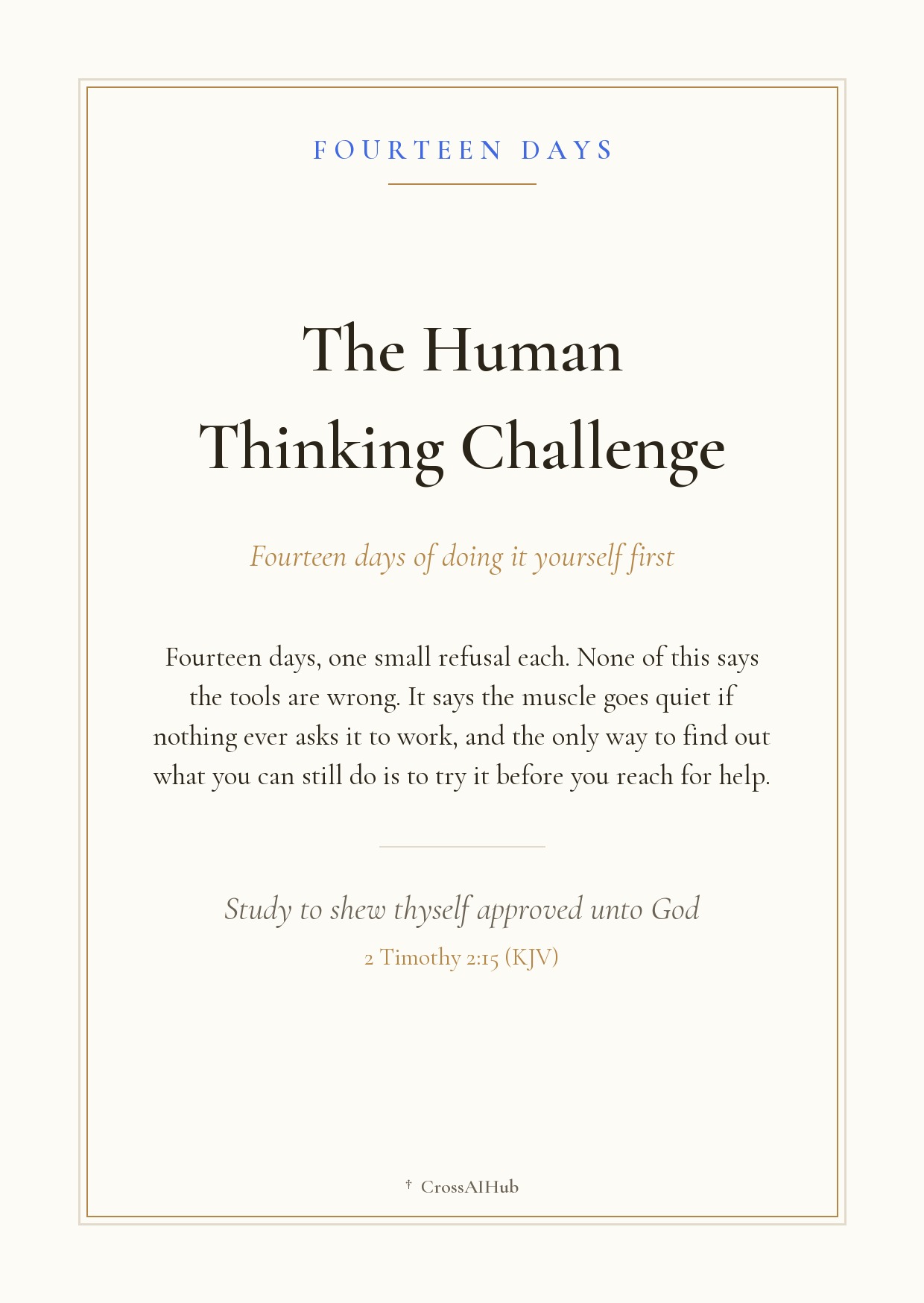
Fourteen days, one small refusal each. None of this says the tools are wrong. It says the muscle goes quiet if nothing ever asks it to work, and the only way to find out what you can still do is to try it before you reach for help.
“Study to shew thyself approved unto God”
— 2 Timothy 2:15 (KJV)
How it works
One card a day. Read it at the table, do the one thing it asks, and stop. The cards are deliberately small — a household that tries to do all of it in a weekend tends to keep none of it.
The 14 days
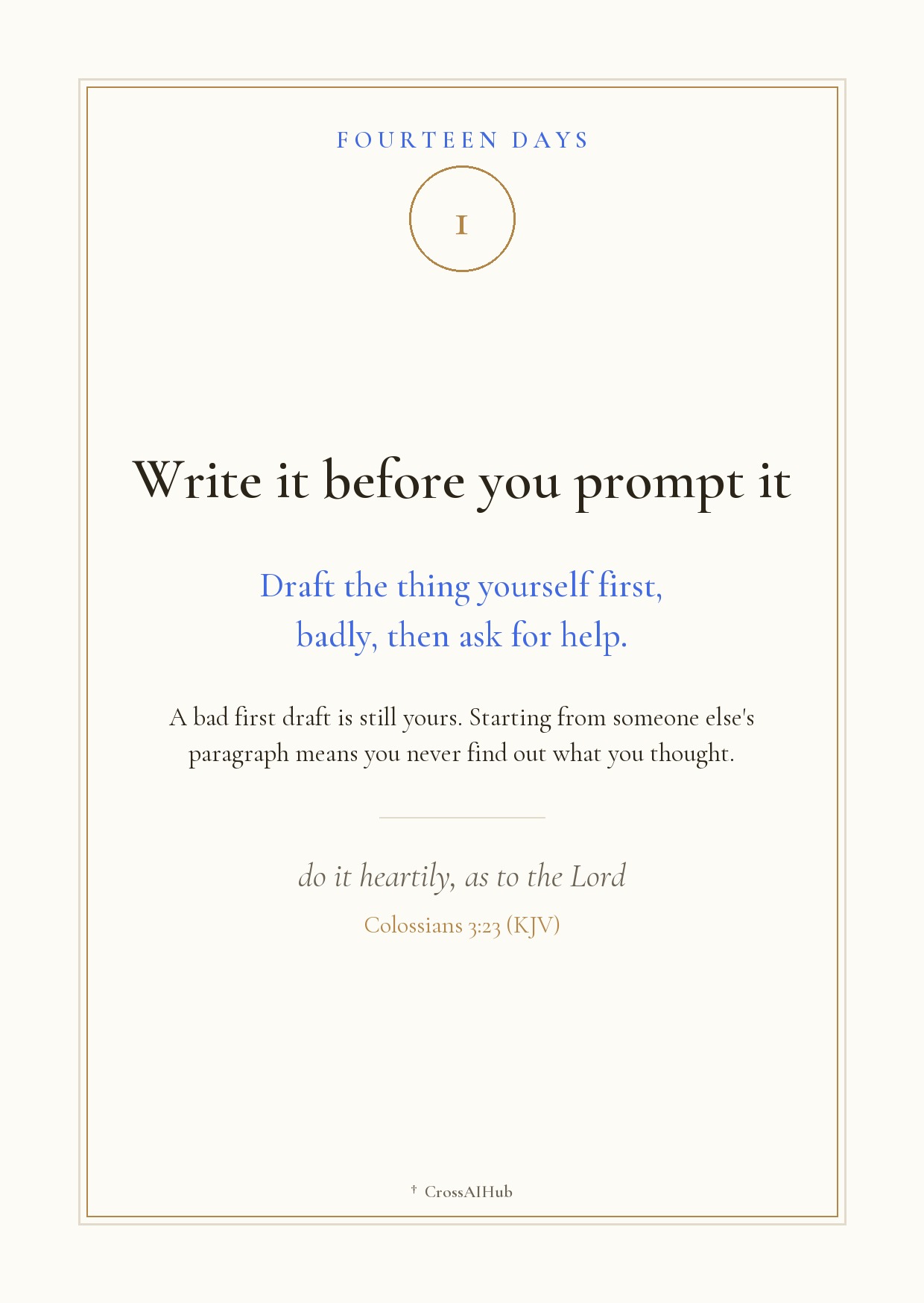
- Write it before you prompt it. Draft the thing yourself first, badly, then ask for help. A bad first draft is still yours. Starting from someone else's paragraph means you never find out what you thought. do it heartily, as to the Lord — Colossians 3:23 (KJV)
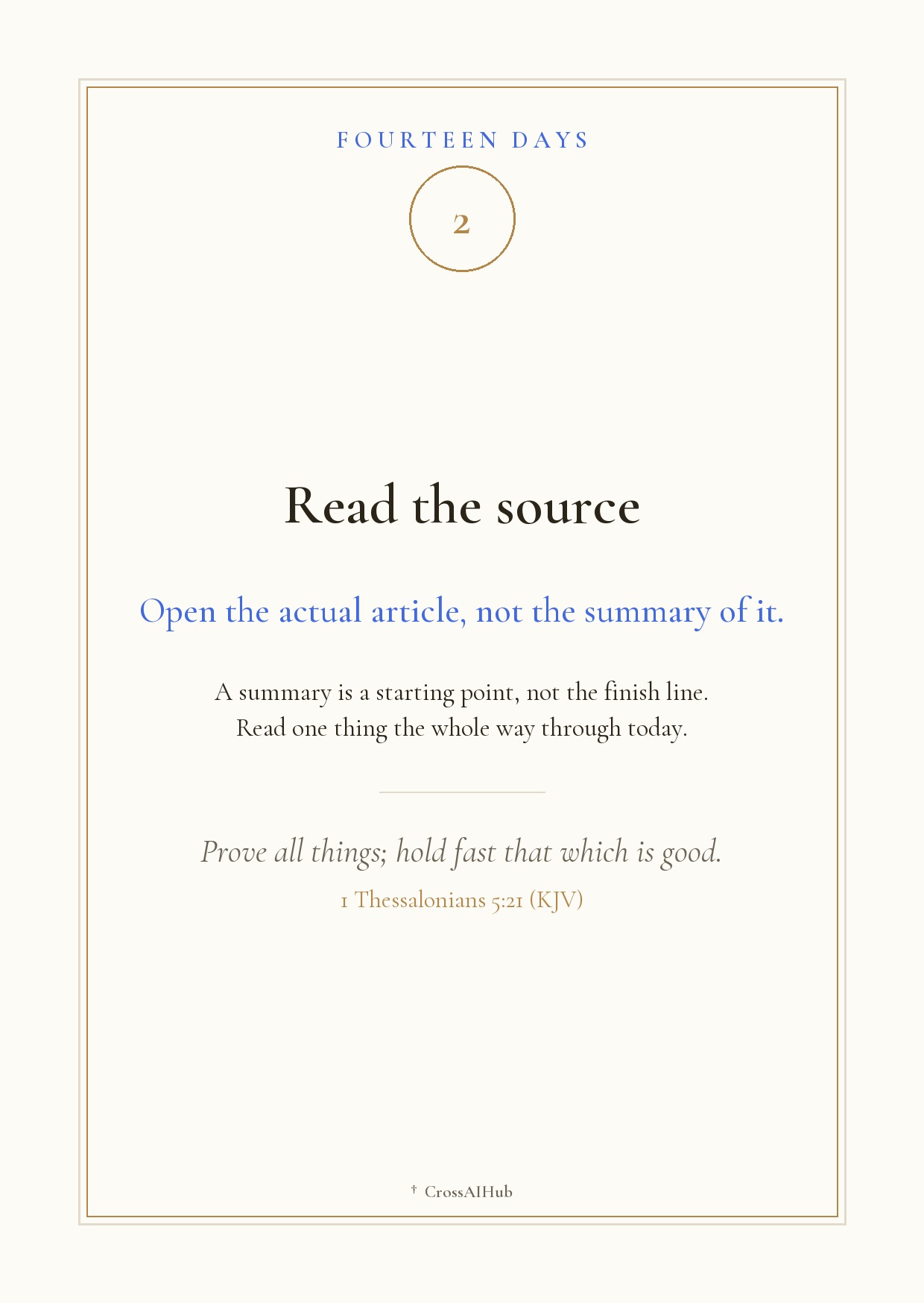
- Read the source. Open the actual article, not the summary of it. A summary is a starting point, not the finish line. Read one thing the whole way through today. Prove all things; hold fast that which is good. — 1 Thessalonians 5:21 (KJV)
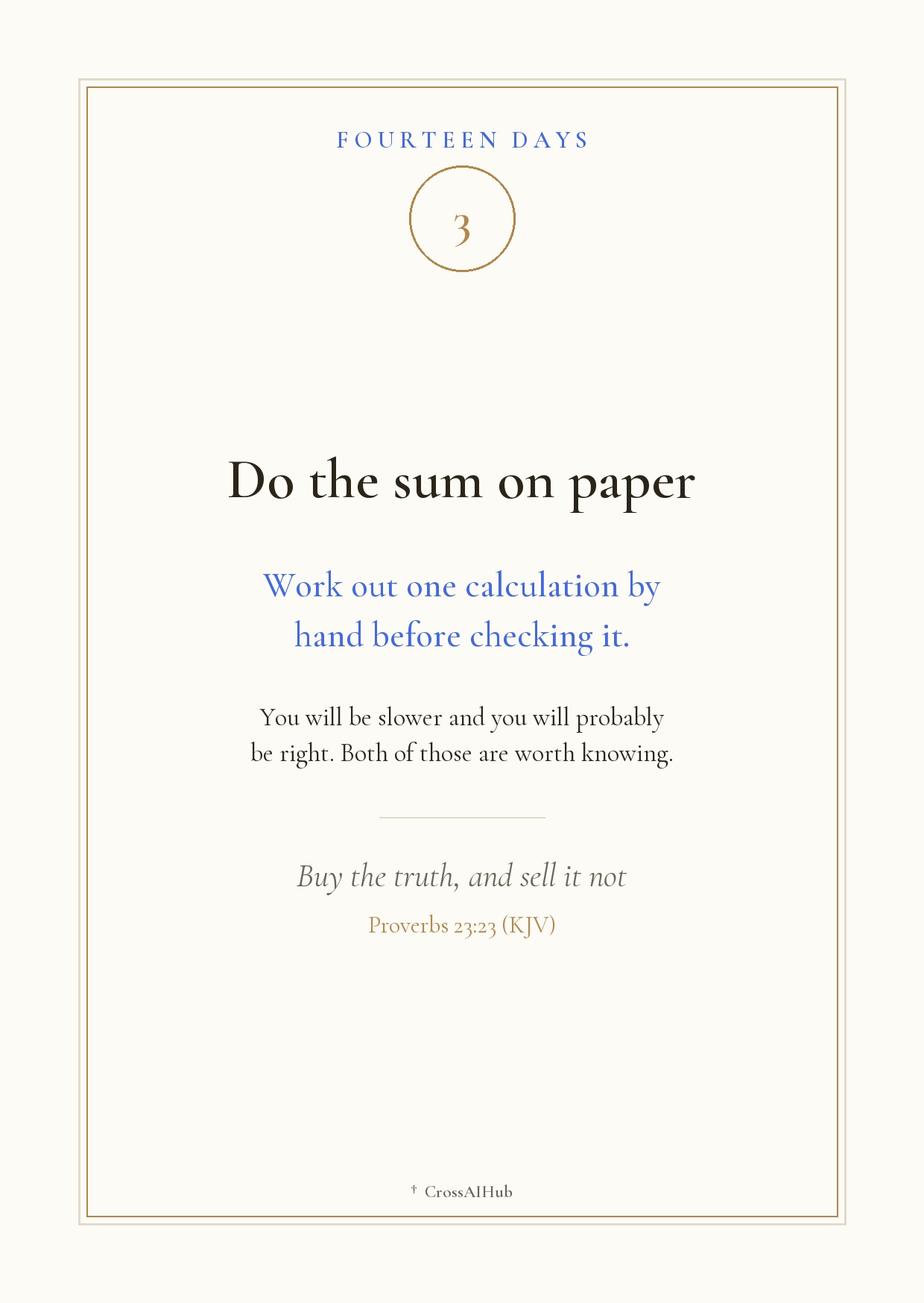
- Do the sum on paper. Work out one calculation by hand before checking it. You will be slower and you will probably be right. Both of those are worth knowing. Buy the truth, and sell it not — Proverbs 23:23 (KJV)
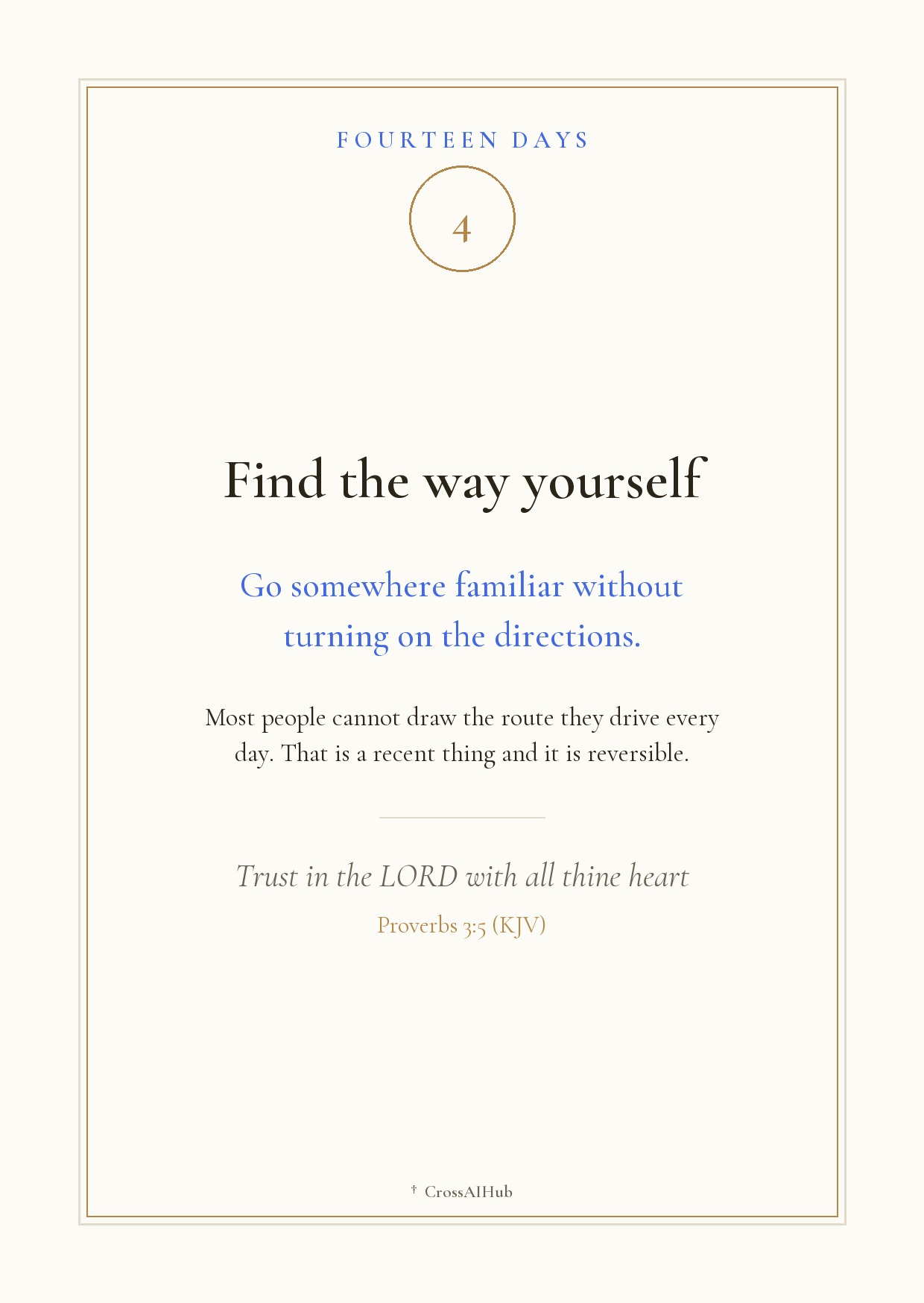
- Find the way yourself. Go somewhere familiar without turning on the directions. Most people cannot draw the route they drive every day. That is a recent thing and it is reversible. Trust in the LORD with all thine heart — Proverbs 3:5 (KJV)
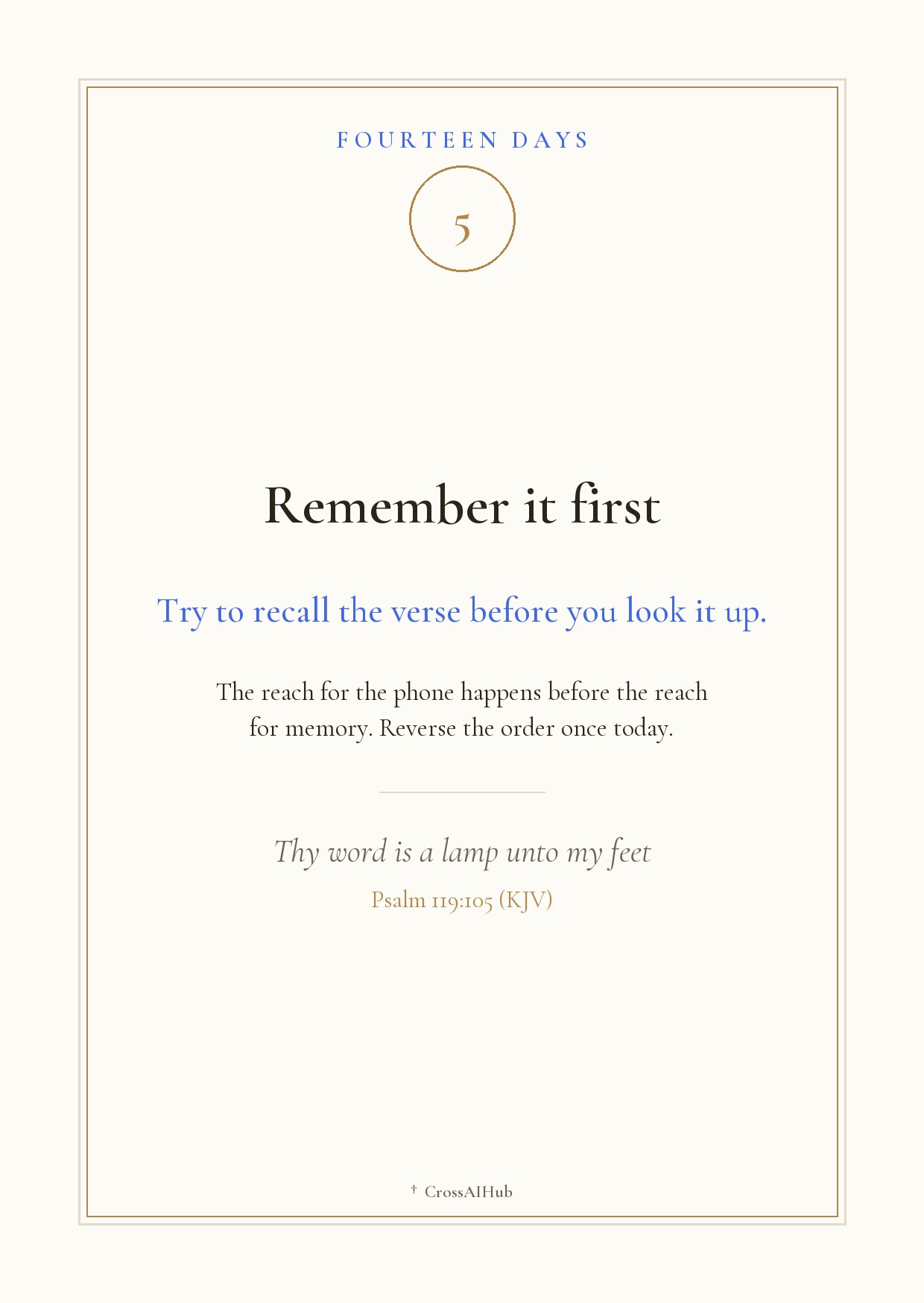
- Remember it first. Try to recall the verse before you look it up. The reach for the phone happens before the reach for memory. Reverse the order once today. Thy word is a lamp unto my feet — Psalm 119:105 (KJV)
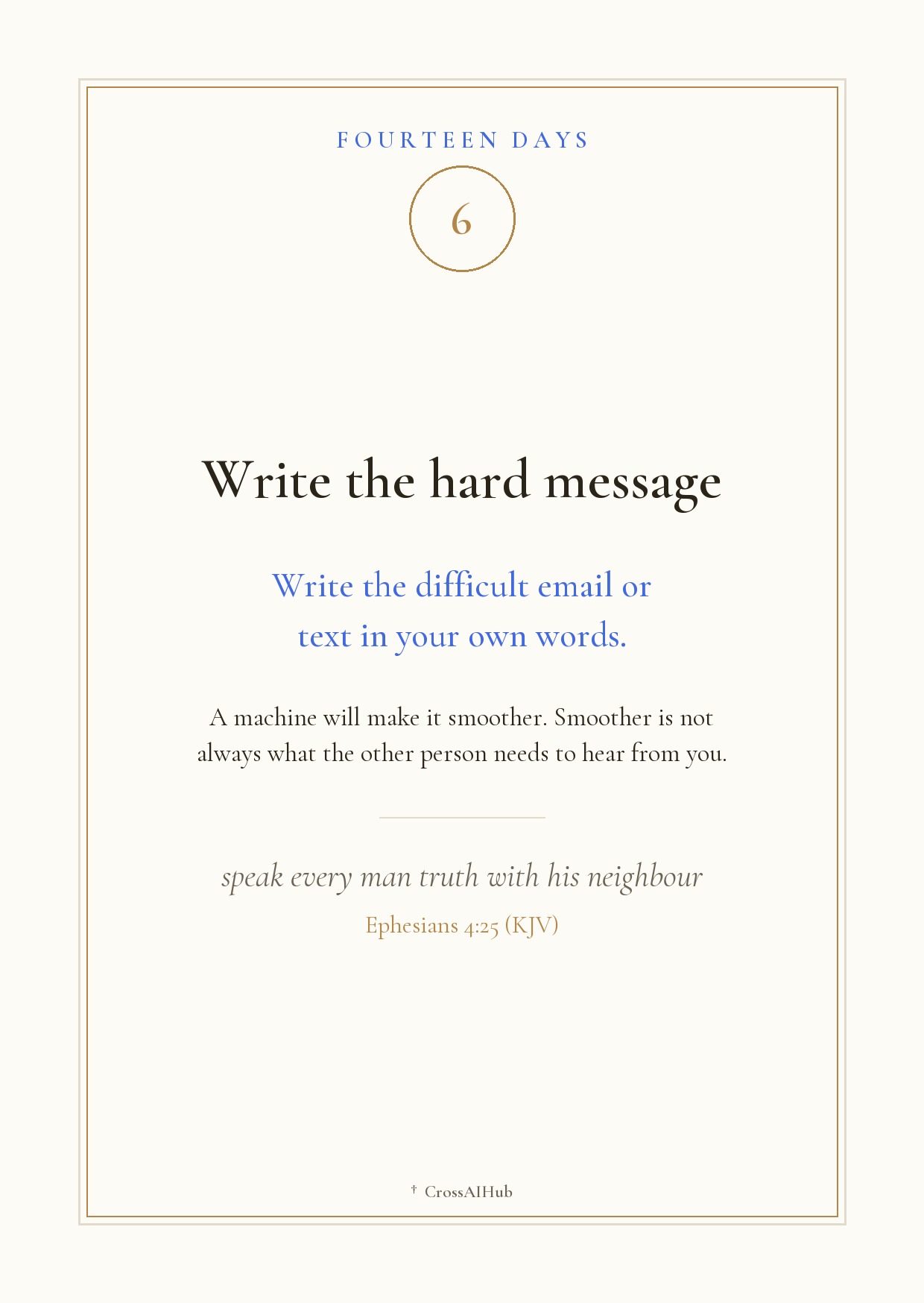
- Write the hard message. Write the difficult email or text in your own words. A machine will make it smoother. Smoother is not always what the other person needs to hear from you. speak every man truth with his neighbor — Ephesians 4:25 (KJV)
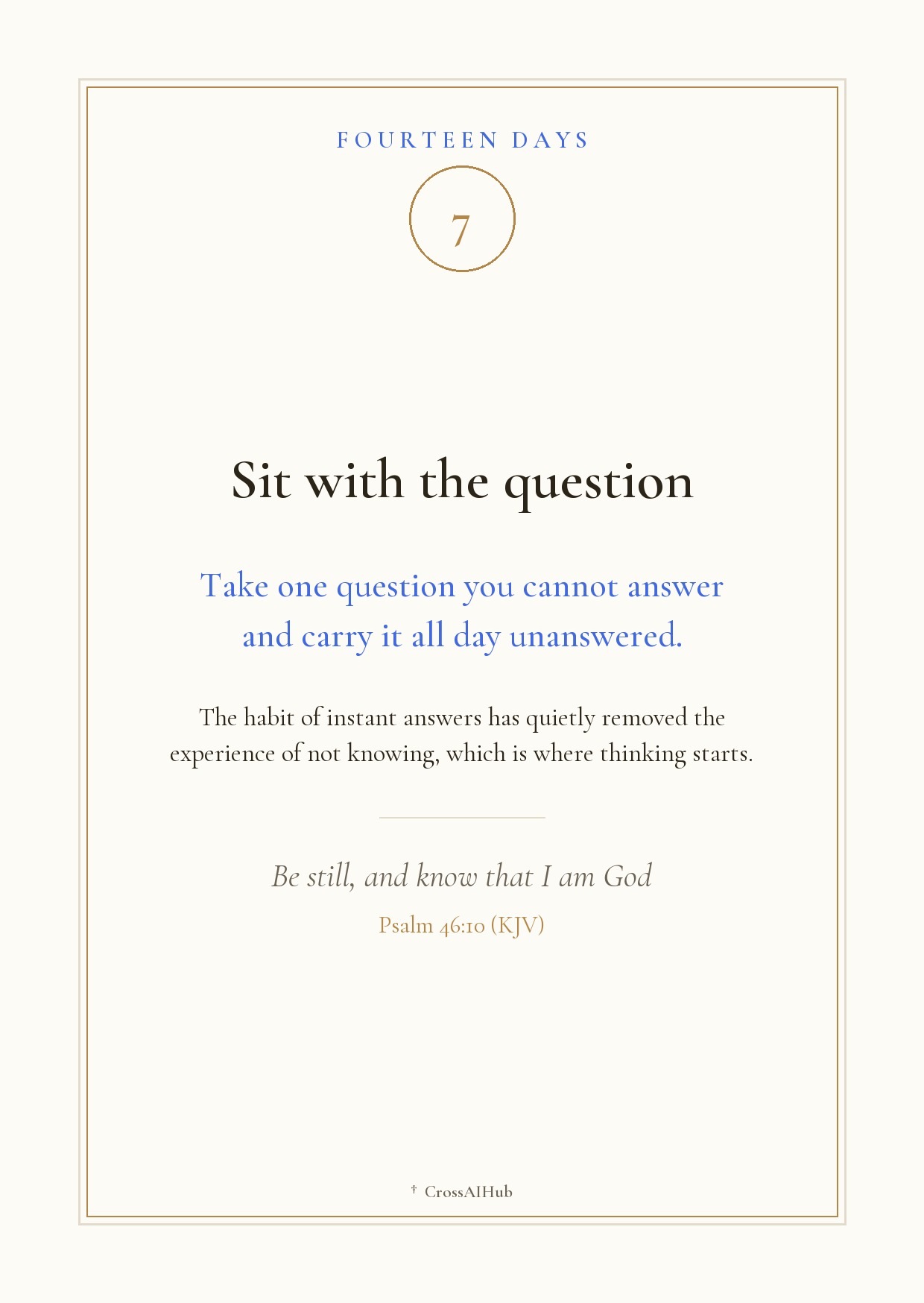
- Sit with the question. Take one question you cannot answer and carry it all day unanswered. The habit of instant answers has quietly removed the experience of not knowing, which is where thinking starts. Be still, and know that I am God — Psalm 46:10 (KJV)
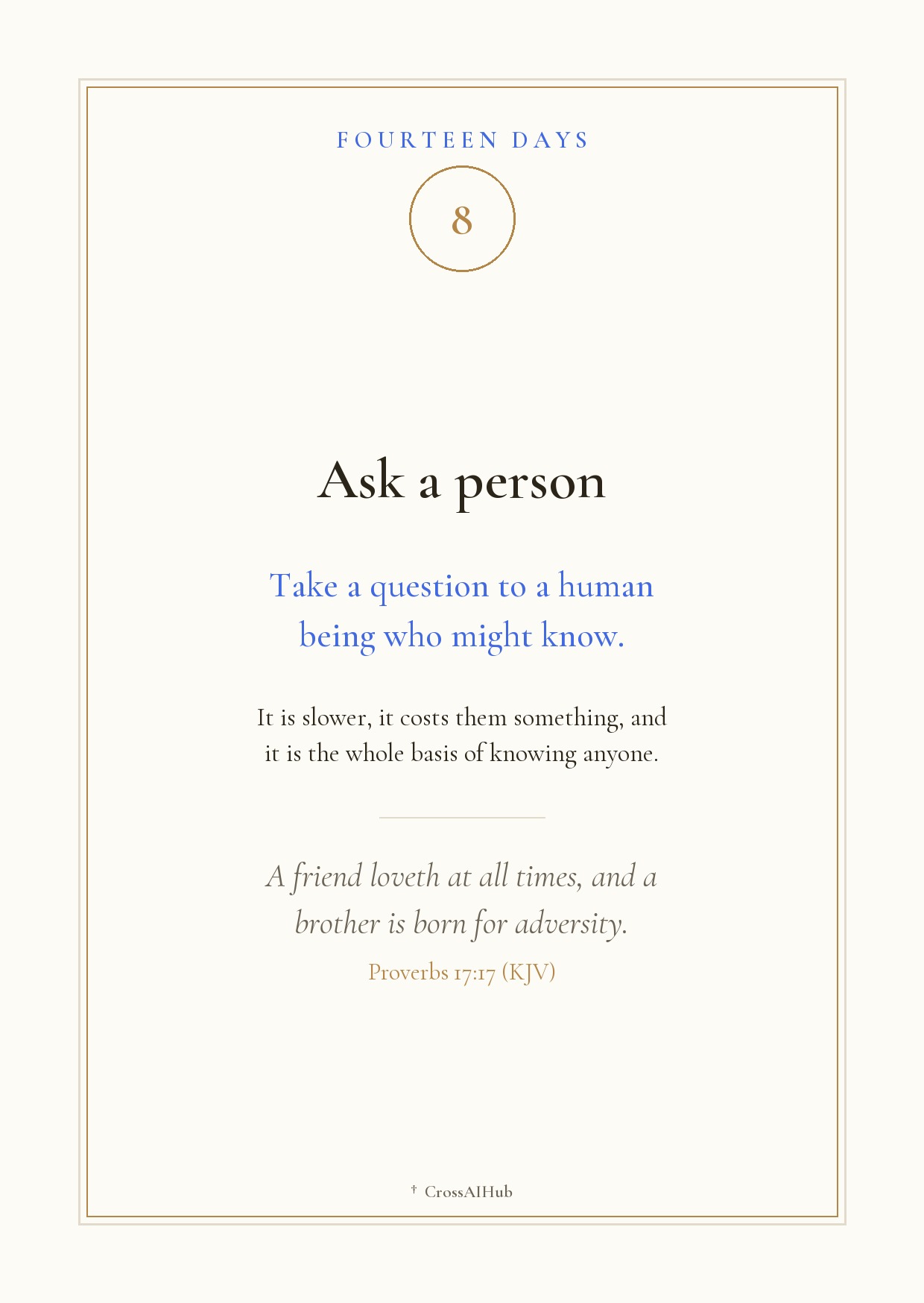
- Ask a person. Take a question to a human being who might know. It is slower, it costs them something, and it is the whole basis of knowing anyone. A friend loveth at all times, and a brother is born for adversity. — Proverbs 17:17 (KJV)
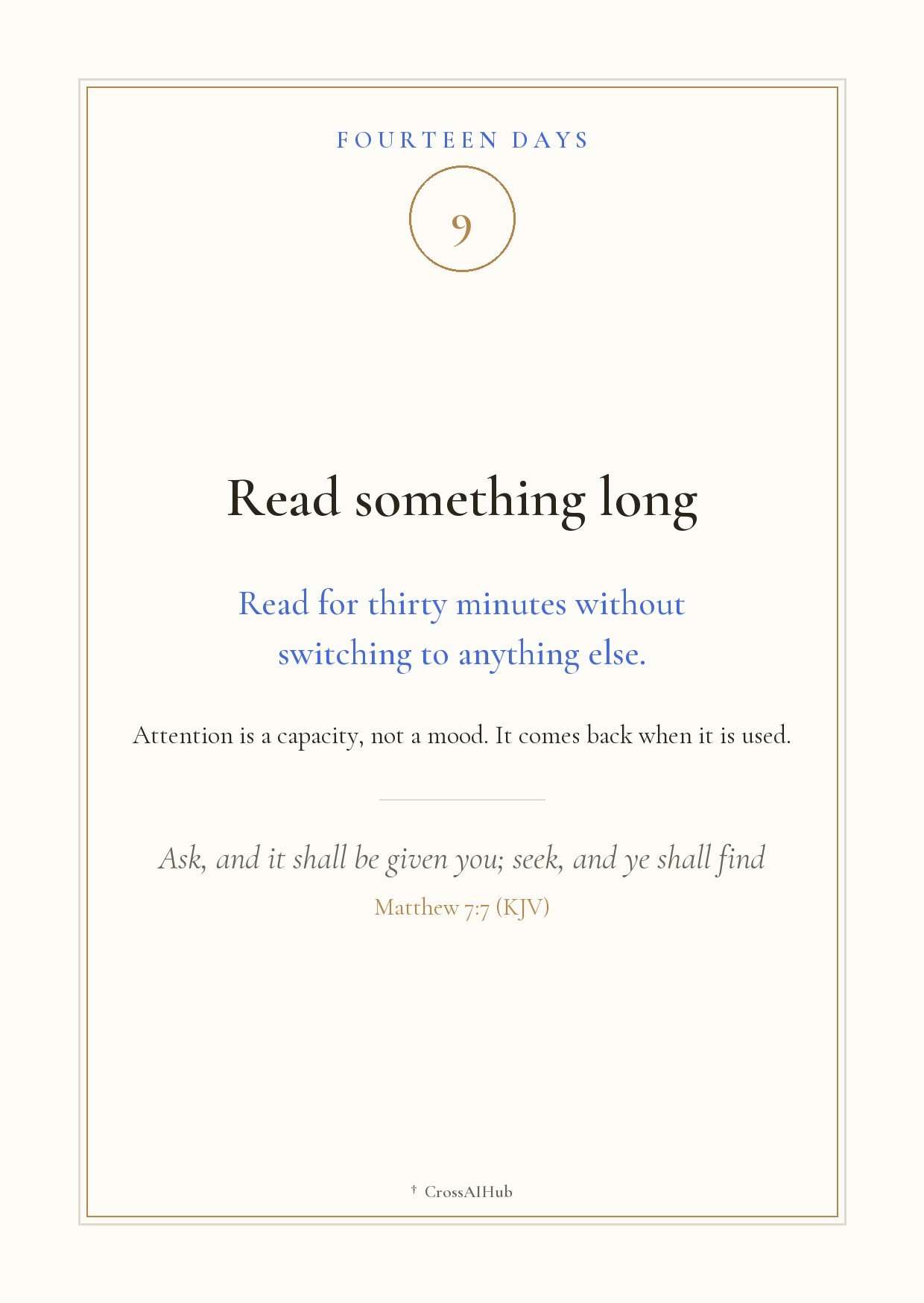
- Read something long. Read for thirty minutes without switching to anything else. Attention is a capacity, not a mood. It comes back when it is used. Ask, and it shall be given you; seek, and ye shall find — Matthew 7:7 (KJV)
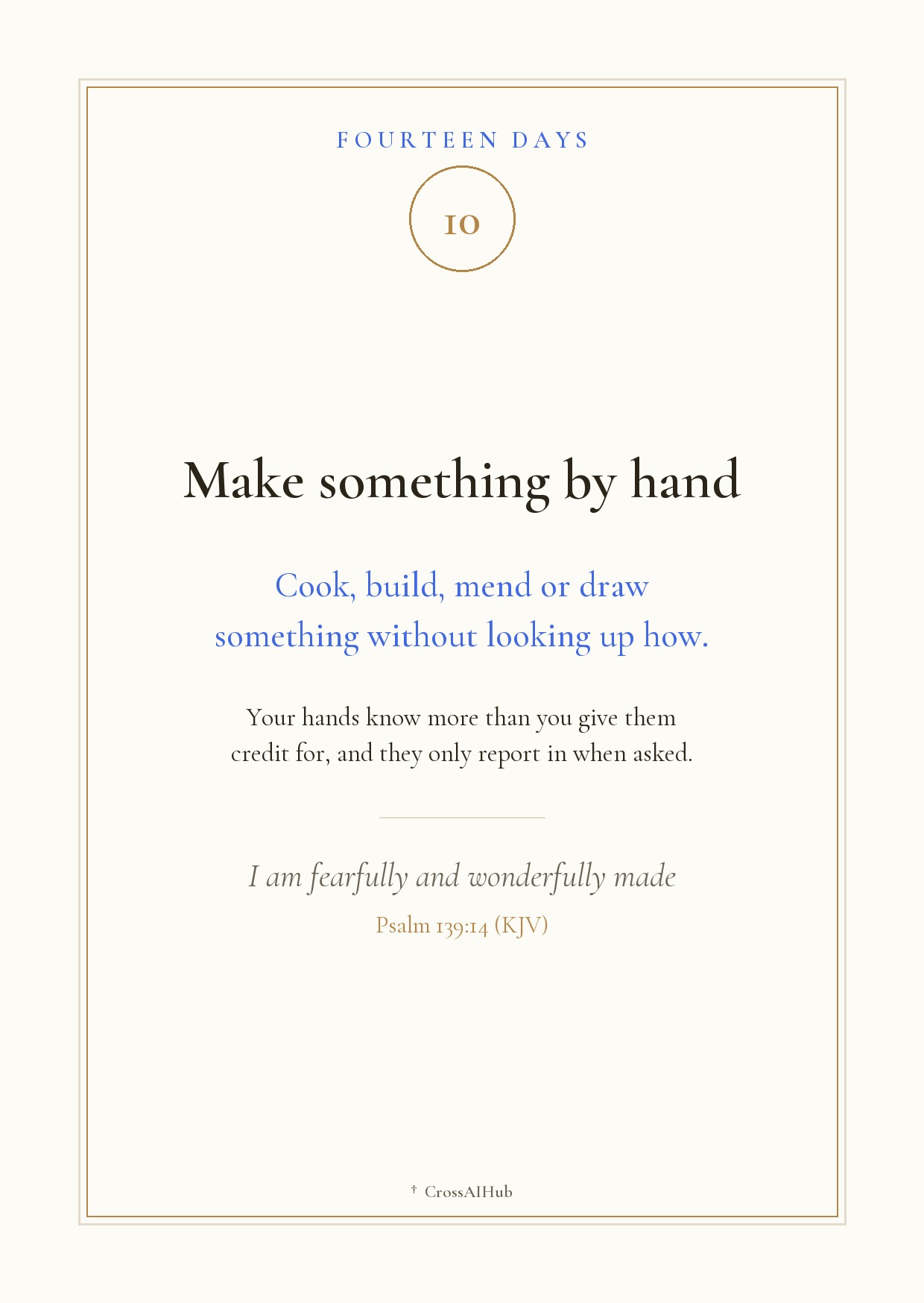
- Make something by hand. Cook, build, mend or draw something without looking up how. Your hands know more than you give them credit for, and they only report in when asked. I am fearfully and wonderfully made — Psalm 139:14 (KJV)
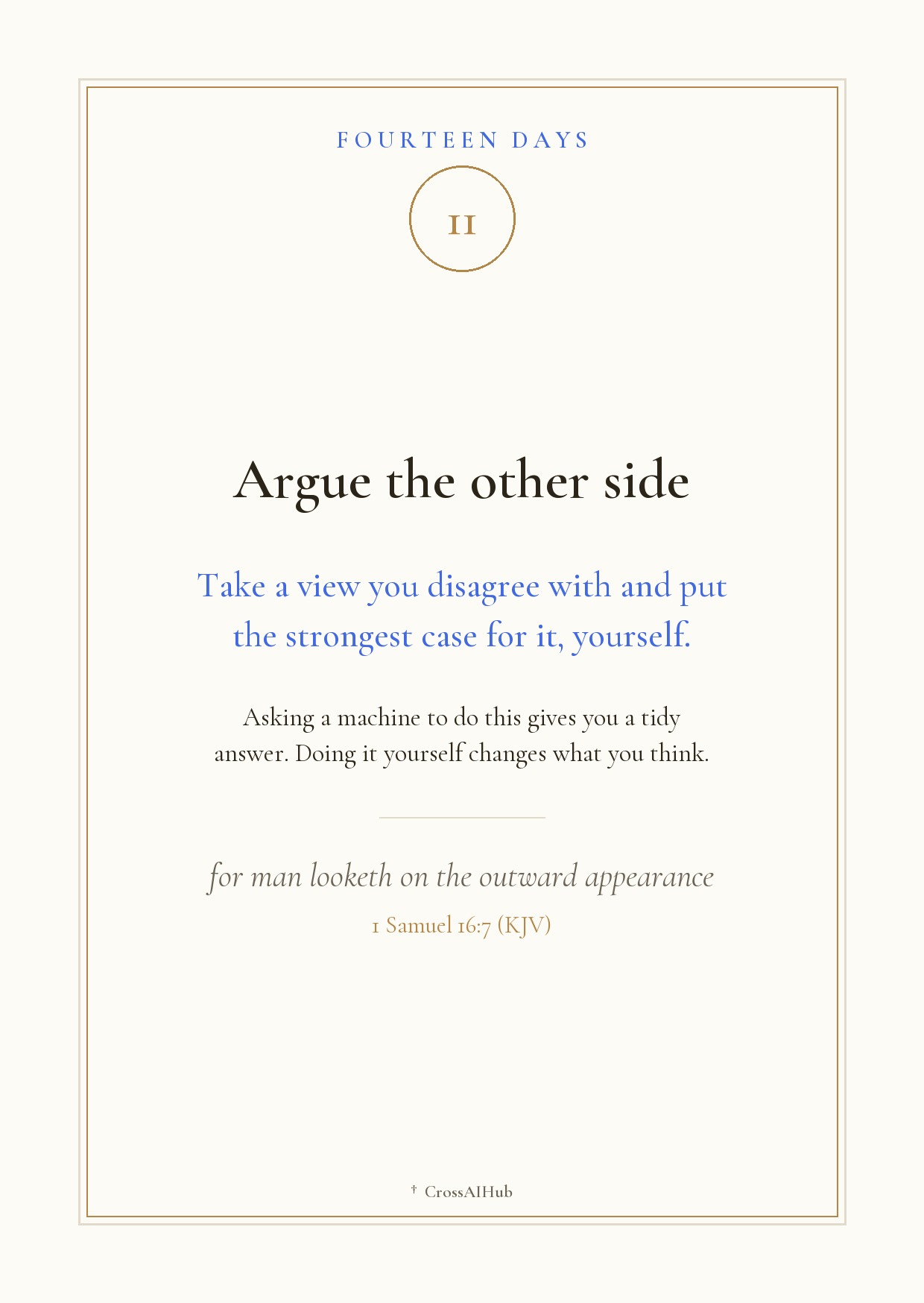
- Argue the other side. Take a view you disagree with and put the strongest case for it, yourself. Asking a machine to do this gives you a tidy answer. Doing it yourself changes what you think. for man looketh on the outward appearance — 1 Samuel 16:7 (KJV)
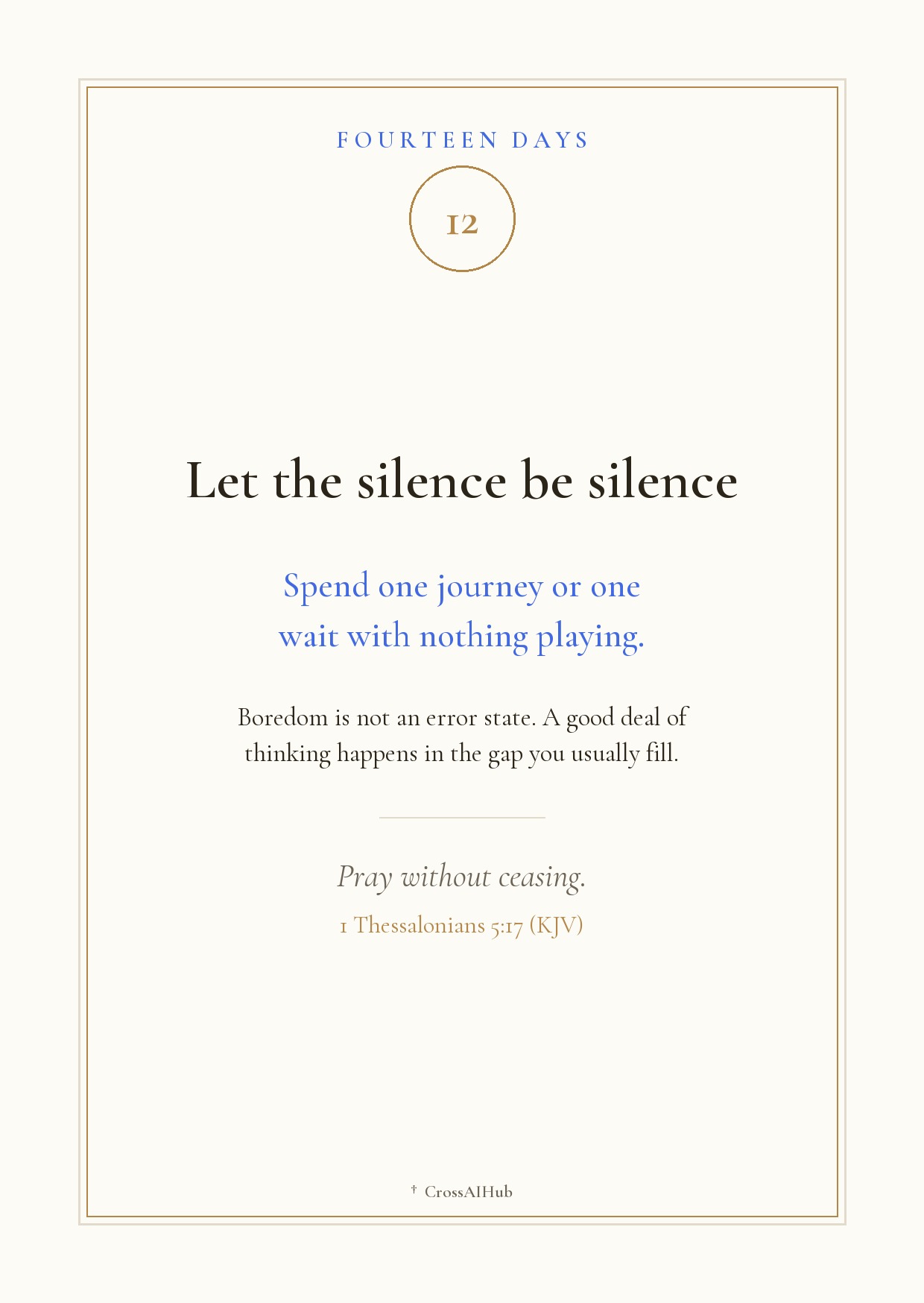
- Let the silence be silence. Spend one journey or one wait with nothing playing. Boredom is not an error state. A good deal of thinking happens in the gap you usually fill. Pray without ceasing. — 1 Thessalonians 5:17 (KJV)
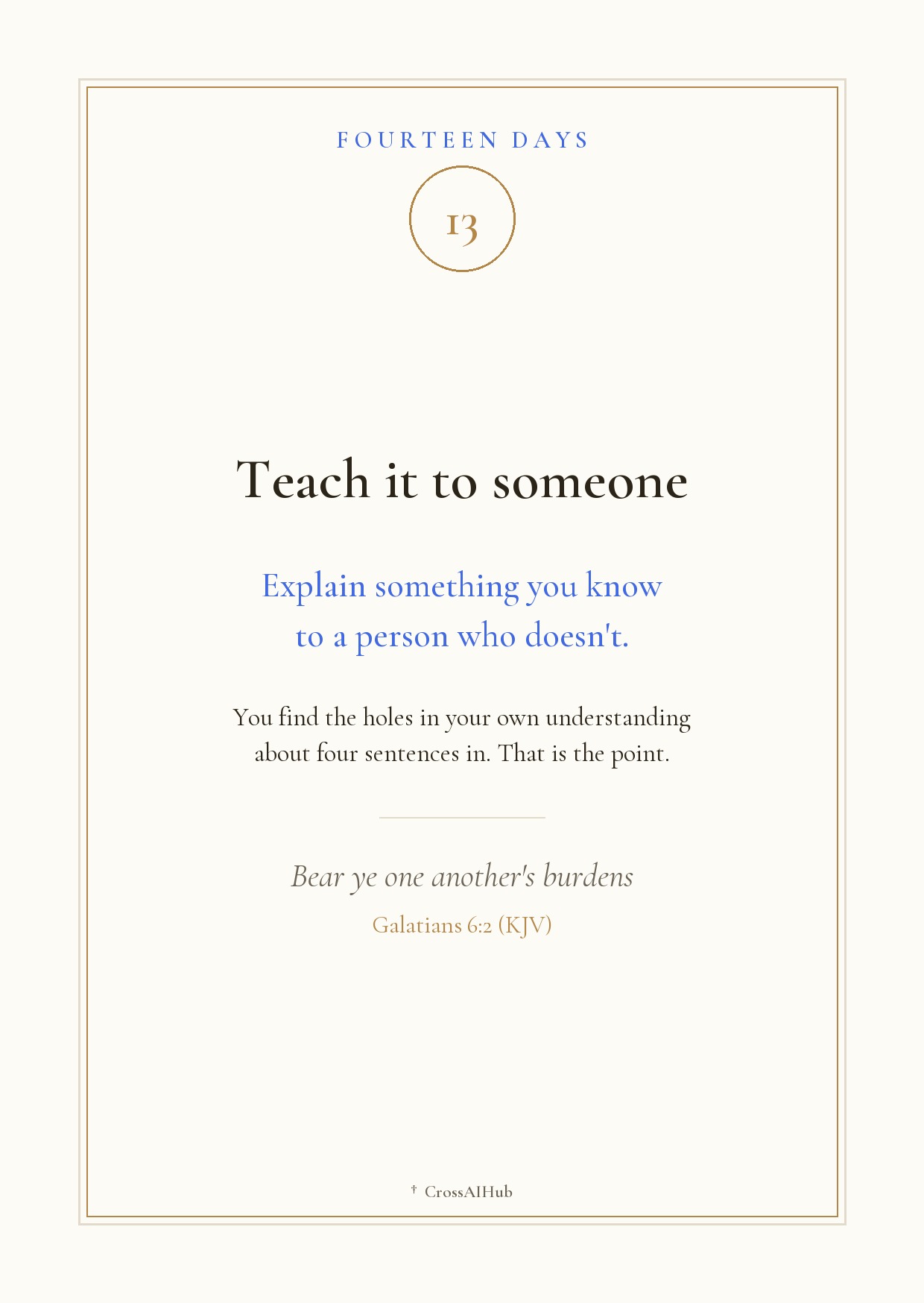
- Teach it to someone. Explain something you know to a person who doesn't. You find the holes in your own understanding about four sentences in. That is the point. Bear ye one another's burdens — Galatians 6:2 (KJV)
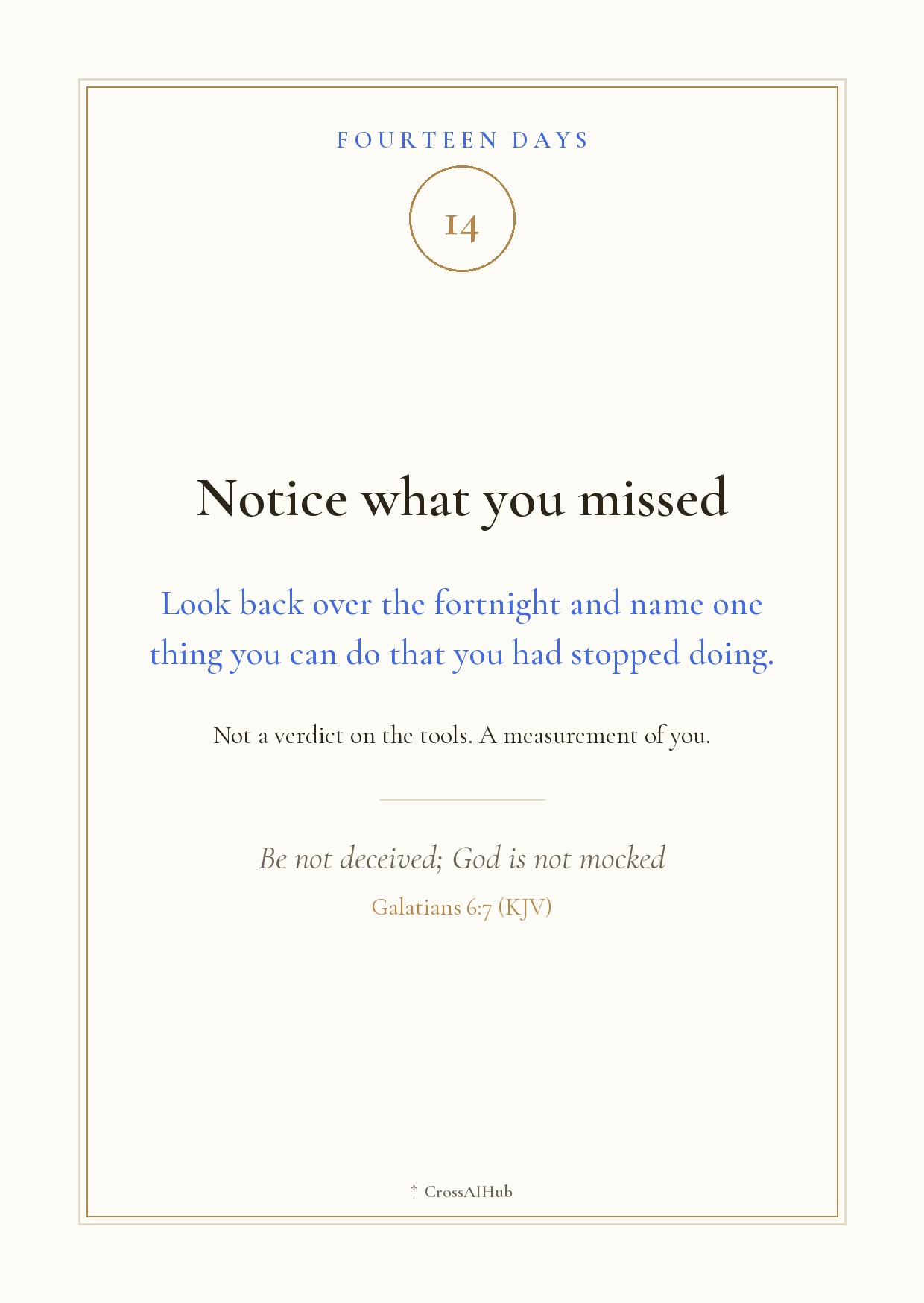
- Notice what you missed. Look back over the fortnight and name one thing you can do that you had stopped doing. Not a verdict on the tools. A measurement of you. Be not deceived; God is not mocked — Galatians 6:7 (KJV)
The cards
One per day, plus a cover. The same cards as the text above, laid out to be read at the table.
If you miss a day
Pick it up where you left it. Nothing here expires, and starting again on Thursday is not a failed attempt. The only version of this that doesn’t work is the one abandoned because a day was missed.
Every card is on this page, free to read. Print the page from your browser if you would rather have them on the table.