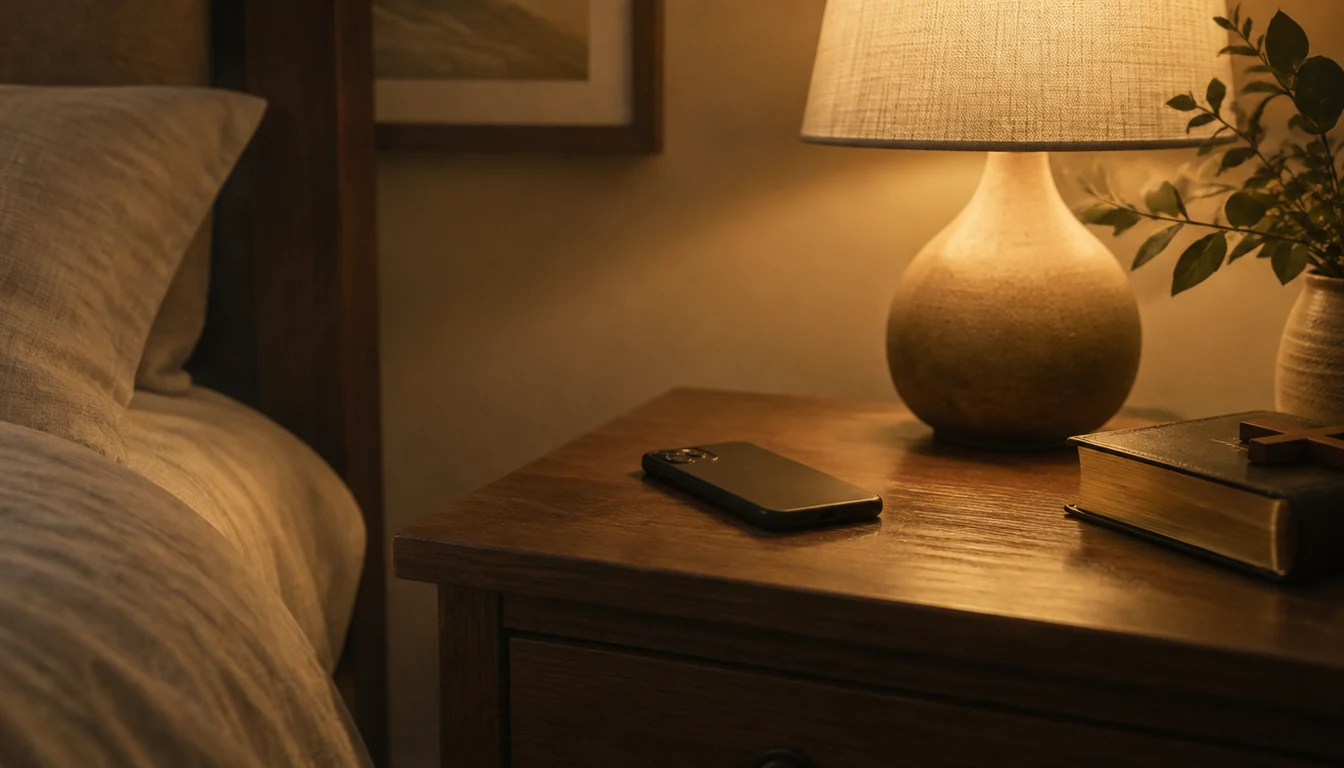
Most writing about families and screens assumes the parent is the one in control, handing down limits to somebody smaller. A good deal of the time that is not the situation. The parent knows the rules are right, sets them, means them, and then finds themselves on the sofa at eleven at night with no memory of the last forty minutes.
That is worth saying plainly, because the silence around it does real damage. A parent in that position usually concludes they are uniquely weak. They are not. They are using a product that was built by competent people to produce exactly that result.
“All things are lawful unto me, but all things are not expedient: all things are lawful for me, but I will not be brought under the power of any.”
— 1 Corinthians 6:12 (KJV)
Why willpower keeps losing
The American Academy of Pediatrics names the mechanism without euphemism. Its guidance describes engagement-based design, features such as autoplay, endless scrolling and targeted advertising, as built to hold attention rather than to serve the person holding the device, and as able to crowd out sleep, play and family time.
Read that as a description of a machine rather than a moral judgment, because that is what it is. There is no natural stopping point in an endless scroll. A book ends. An episode used to end. A feed is built specifically not to, and a tired adult at the end of a long day is the easiest case it will face all week.
So the common advice, try harder, is advice to win a contest that is arranged against you. It fails, the failure is read as a character defect, and the shame makes the next evening worse. The way out is not more resolve. It is changing the arrangement.
Change the arrangement, not the resolve
These are in order of how much they do for how little they cost.
- Move the charger out of the bedroom. This single change does more than any app, because it removes the device from both ends of the day at once.
- Turn off notifications that are not people. Keep calls and messages from humans you know. Switch off everything that is a company asking for your attention. The quiet is startling for about two days.
- Take the worst app off the phone and keep it on a browser. Not deleted, not sworn off. Just moved somewhere that requires a decision rather than a thumb.
- Give the evening a shape. The scroll fills a vacuum. A book on the arm of the chair, left open, competes better than an intention does.
- Tell one person. A spouse, a friend from church. Not as confession, as arrangement. The thing done in private is the thing that keeps its grip.
On telling your children
Many parents hide this, assuming that admitting it undermines their authority. The opposite is closer to the truth.
A child who watches a parent set a standard, fail it, name the failure, and start again has been shown something they will need far more than a clean record. They have been shown what repentance looks like when it is ordinary rather than dramatic. A parent who only ever appears to succeed teaches, by accident, that failure is unspeakable, and a teenager who learns that will hide theirs.
You do not owe your children a full account. Is this mine to tell them, or am I asking them to carry it? is the right question. A sentence is usually enough. The phone has been getting too much of my evening, so it charges in the kitchen now.
“And, ye fathers, provoke not your children to wrath: but bring them up in the nurture and admonition of the Lord.”
— Ephesians 6:4 (KJV)
When it is bigger than a habit
There is a line past which this stops being a habit worth adjusting, and the honest thing is to mark it rather than blur it.
If the pull is costing sleep most nights, if it is reaching into work or driving, if attempts to stop have produced real distress, or if what is being reached for has moved from dull to shameful, that is not a scheduling problem. Speak to your doctor, and speak to your pastor. Both conversations are harder to start than a basket on the counter, and both are the right size for the problem.
For most households it is not that. It is an ordinary habit that grew in the dark because nobody said it out loud. Said out loud, with the charger moved and one person told, it usually gives ground faster than expected.
If a long and slow version suits your household better than a quick correction, there is a hundred-day reset. The habits the children are copying have a guide of their own.