This page is a plain, working policy for a small project, written by us in good faith — not a substitute for professional legal advice.
WHY THIS PAGE EXISTS
Why Christian families need a thoughtful approach to AI.
AI is already shaping the way your children read, write, study, and ask questions. That is not a prediction. It is happening in autocomplete and search results, in homework help and video feeds, in the smart speaker on the kitchen counter. The question is not whether to engage but how, and on whose terms.
A Christian lens does not mean fear. It means proportion. AI is a powerful tool; Scripture, prayer, and the local church remain the soil. The job of a Christian household is to keep those in order — soil first, tool second — so that the tool serves what the family already loves, rather than quietly reshaping it.
Some families are panicked about AI. Some are unbothered. Most are tired, busy, and unsure what to do. This page is for that middle. It is a short field guide for steady households who want to be wise without becoming anxious. We will not promise certainty; we will offer practice.
"Prove all things; hold fast that which is good." 1 Thessalonians 5:21
OUR SCOPE
What CrossAIHub teaches — and refuses to teach.
CrossAIHub stays on the small piece of ground where Scripture, calm reasoning, and practical AI literacy meet. Outside that ground, we point to better sources.
We do teach
- What AI actually is, in plain language a family can use together.
- How to use AI as a careful study companion for Scripture — without letting it lead.
- Safe habits for the home — when to lean on AI and when to set it down.
- The verification habit — how to check AI's output before letting it shape what you believe.
- Devotional rhythms tied to the Christian year and the gathered church.
- Family conversation patterns — age-appropriate phrases parents can borrow.
- A theology of AI rooted in Genesis and John 1, calm and not alarmist.
We do not teach
- Sectarian distinctives or denominational positions. Universal Christian only — the Nicene Creed common ground.
- Doctrine that you should be receiving from your pastor, priest, or local church.
- Personal counseling, mental-health diagnosis, or pastoral care.
- Technical AI engineering — model training, professional prompt design.
- Predictions about what AI will or will not do five years from now.
- Anything that uses urgency, fear, or hype to make you click or to grow our list.
METHOD
The 4-step Scripture verification habit.
Whenever AI quotes or explains a Bible passage, run these four small steps before you let the answer change what you believe. They take only a few minutes. They will save you a great deal of slow drift.
- Read the verse in full, in context. Open the chapter around it in your printed Bible (or a clean digital one). Three verses before, three verses after, at minimum. The verse is part of a paragraph; the paragraph is part of a book.
- Compare two or three trustworthy translations. If the AI quote and the printed Bible disagree on a word, the printed Bible wins. The King James Bible — the edition this house cites — alongside whichever others your tradition trusts.
- Check what the historic church has said. If an AI reading contradicts the broad witness of two thousand years — the Apostles' Creed, the Nicene Creed, the consistent teaching of historic Christian traditions — that is a serious signal. Treat it as a hypothesis to investigate, not as a finding.
- Ask whether it bears good fruit. Does this reading draw you toward love of God and neighbor? Toward humility? Toward the cross and the resurrection? If not, set it aside and ask a pastor or elder.
For the longer version of this habit — with worked examples and doctrinal red flags — see the verification habit lesson. To practice on five short answers, try Spot the Hallucination.
FOR THE HOME
A safe-AI checklist for Christian households.
Print this. Tape it inside a kitchen cabinet. It is short on purpose — eight short lines a child can read and an adult can keep.
- Open conversation, not hidden use. AI is something we do together, not something we sneak off to. The chat window is not private.
- Scripture before screen. When the topic is the Bible, the printed text leads. The AI assists. Never the other way around.
- No AI as a substitute for a person. Not for a parent. Not for a pastor. Not for a friend. Not for prayer.
- If you are not sure it is true, you do not yet know it is true. Verify before sharing. Confident does not mean correct.
- Sabbath the tool. One 24-hour window each week with the AI closed. The home becomes quieter and louder in good ways.
- Praise the AI when it admits it does not know. Teach children that "I'm not sure" is wisdom — in machines and in people.
- Real names stay out of the chat. Treat the chat window like a postcard, not a sealed letter.
- We do not replace prayer with prompts. Prayer is offering yourself to God. A prompt is asking a machine to produce text. They are not the same kind of thing.
WHEN IT GOES WRONG
When AI gets it wrong — 5 calm steps.
It will happen. A wrong date. A misquoted verse. A confident sentence that is simply not true. A reading that sounds reasonable but disagrees with the consistent teaching of the church. The right response is calm — and teachable.
- Pause. Do not pass the wrong thing along to anyone. Not in a text, not in a sermon, not at the dinner table, not on social media. Hold it where it is.
- Cross-check. Compare the claim against a trusted printed source. The Bible for Scripture. An encyclopedia or official site for facts. Your church's catechism or a historic creed for doctrine.
- Tell the AI what was wrong. Plain language. "Your quote of Psalm 23 changed three words. Here is the printed version." Many tools will correct themselves; some will not. Either way, your verification habit grows stronger.
- Talk about it with the children. A wrong answer caught is a lesson learned. Hidden failures are the dangerous kind. Saying out loud "the computer got this wrong, and here is how we knew" is the most useful AI conversation a parent can have with a child.
- If a piece of CrossAIHub content is wrong, tell us. Reach the team. We correct things openly, name the change, and date the correction.
FOR THE SHEPHERDS
A note for pastors and elders.
CrossAIHub is a small project by lay Christians, made to serve families in your congregations. We do not see ourselves as a teaching authority. The teaching authority is the gathered church under the Word.
If you find something here that contradicts sound doctrine, please tell us. Doctrinal correction from any historic Christian tradition is welcomed — Catholic, Orthodox, Reformed, Lutheran, Anglican, Baptist, Coptic, Pentecostal. We would rather be corrected than be right by accident. Reach the team at the Connect page.
And if these lessons are useful — to a small group, a Sunday school class, a homeschool co-op, a family in your care — you are free to use them, adapt them, and pass them on. There is no copyright to enforce here; there is only an offering.
THE WEBSITE ITSELF
Is CrossAIHub itself safe for my family to use?
The rest of this page is about trusting AI’s answers. This part is about trusting the website.
- Hosting and security. The site is served over HTTPS. We do not ask for passwords or accounts to read anything here, so there is no account database to be breached.
- No explicit content, ever. Nothing sexual, violent, or otherwise inappropriate for a family setting is knowingly published on this site, on any page.
- No ad networks, no ad trackers. We do not run advertising of any kind (see No Ads, No Cross-Site Tracking). One exception: pages with an embedded YouTube video load YouTube, which may set its own cookies, including for advertising (see Privacy).
- Screened before it appears. The only place visitors can post is the prayer box. Every request passes an automatic screen for cruelty, explicit content, scams and contact details; anything it catches waits until a person reads it, and the rest appear after a few minutes. Full detail: Community Guidelines.
- A concern? Write to us at hello@crossaihub.com or visit Connect. We read every message.
IF YOU WANT A ROUTE THROUGH IT
Seven evenings, one job each.
The guides below are a reference — useful when you need them, easy to leave unread. If you would rather be walked through, The Seven-Day Home Safety Challenge turns them into one job a night for a week, about twenty minutes each.
It is one of four challenges, all free to read.
GUIDES IN THIS ROOM
The practical ones.
The page above is the policy. These are the walk-throughs — one household job each, written to be finished in a sitting.
 SafetyWhat’s actually on your home networkYour Wi-Fi is closer to a shared room than a set of private tunnels.Inside · SafetyYour Wi-Fi is closer to a shared room than a set of private tunnels. How to take an inventory of what’s connected, and the one change that helps most.
 SafetyThe router settings that matterSeven settings, in the order worth doing them.Inside · SafetySeven settings on a home router, in the order worth doing them, drawn from published guidance by CISA, the FTC and the UK National Cyber Security Centre.
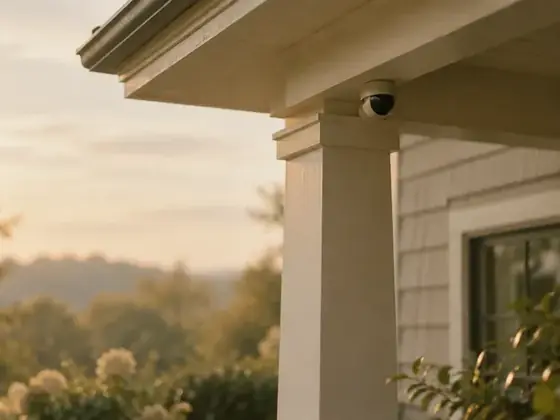 SafetyA walk through your home camerasFour questions at each camera: what it sees, whose password it uses, who else can reach it, whether it…Inside · SafetyCameras and baby monitors point inward. A room-by-room checklist for what they see, who else can reach them, and which settings to change first.
 SafetyWhat the smart speaker hearsHow it decides what to record, where that goes, and the four settings worth changing.Inside · SafetyHow a smart speaker decides what to record, where those recordings go, and the settings that let you review, auto-delete or mute them.
 SafetyOn your device, or someone else’s computerSome AI runs on the phone in your hand.Inside · SafetySome AI features run on the phone in your hand. Others send your words to a company’s servers. How to tell the difference, and when it matters.
 SafetyA family code wordA cloned voice can copy how someone sounds, but not a word agreed at your own table.Inside · SafetyVoice cloning has made the ‘I’m in trouble, send money’ call sound like your own child. A code word costs nothing and takes one conversation.
 SafetyWhen something goes wrongFour situations and what to do in the first hour.Inside · SafetyFour situations a household may face with AI and connected devices, and what’s worth doing in the first hour of each. Written to be read before you need it.
 SafetyThe habits your children are copyingChildren learn what a phone is for by watching the adults.Inside · SafetyChildren learn what a phone is for by watching the adults. A look at what gets modelled at home, and the four moments where it shows most.
 SafetyYour phone at the tableMeals, mornings, pick-up and the hard conversation — what to do with a phone in each.Inside · SafetyMeals, mornings, pick-up and the hard conversation. What to do with a phone in the four moments where a household is actually formed.
 SafetyWhen you are the one who cannot put it downFor the parent whose own habit has got away from them.Inside · SafetyAn honest guide for the parent whose own phone habit has got away from them. What the pull is, why willpower keeps failing, and what actually helps.
 SafetyWhat a photo of your child is carryingPhotos store the exact spot they were taken.Inside · SafetyPhotos often store the exact spot they were taken, the time, and the device. Check any JPEG here and get a clean copy. Nothing is uploaded.
 ActivityHuman Skills — the off-screen libraryThirty-four things a household can do without a screen, sorted by how long they take.Inside · ActivityThirty-four things a household can do without a screen, sorted by how long they take: ten minutes, half an hour, an afternoon, an evening with others.
 SafetyThe Household CovenantThe rules we’ve written down for our own house, free to copy and change.Inside · SafetyTen short vows for the household — read together, signed if you wish, kept where the children can see it.
 SafetyPrivacy by designWe review other people’s apps, so here is what this site collects, and what it can’t.Inside · SafetyA site that reviews other people’s apps should be cleaner than the apps it reviews. Eight principles, what each one looks like in our code, and the one still unfinished.
 SafetyWhat these apps don’t sayWe asked eight family-safety questions of nineteen widely-used apps, using only what each company publishes.Inside · SafetyWe asked eight family-safety questions of 19 widely-used apps using only what each company publishes. 118 of 152 attempts had no answer.
Doctrinal correction welcomed from any historic Christian tradition. This is a learning project — and we are learners too.